The short answer
Look up at the nave vaults before you move, then turn around for the west rose and the great organ, which almost everyone misses. Stand at the crossing where the north and south roses face each other, find the Virgin of Paris on the southeast pillar, and circle the ambulatory for the 14th-century choir screen and the Mays paintings. Forty-five minutes covers all of it at a walk.
Step through the great west doors of Notre-Dame and it is easy to be overwhelmed. The interior is vast, and much of what makes it extraordinary is easy to miss without knowing where to look. Here are the highlights worth slowing down for — and why each one matters.
The nave and the vaults
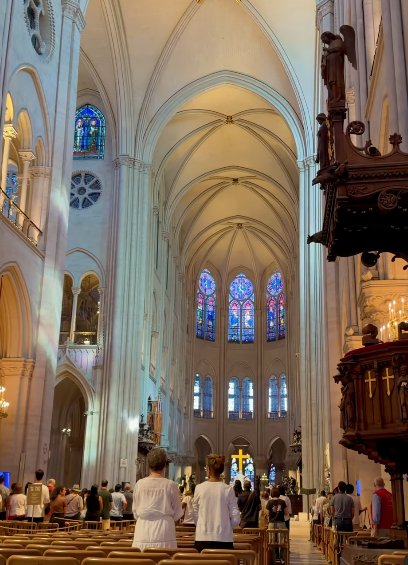
Look up first. The nave rises to rib vaults roughly 33 metres above the floor, carried on slender piers that draw your eye toward the light. This soaring verticality was the whole point of Gothic architecture, made possible by the flying buttresses outside that take the weight of the roof off the walls. Since the restoration, the cleaned pale stone makes the height feel greater still.
The three rose windows
Notre-Dame's rose windows are among the finest in the world. The north rose, from around 1250, is the star: it still holds most of its original 13th-century glass, glowing in deep medieval blues and reds. The south rose faces it across the transept, a gift associated with Louis IX, while the smaller western rose sits above the main entrance. Find the spot where you can see the north and south roses together and the whole transept lights up.
The great organ
High on the west wall sits the grand organ, rebuilt in the 19th century by the master builder Aristide Cavaillé-Coll and one of the largest in France. If you can time your visit to a service or a recital, hearing it fill the nave is unforgettable. We cover the cathedral's calendar on the events page.
The Crown of Thorns and the Treasury
The cathedral's most venerated relic, the Crown of Thorns, was famously rescued from the fire and is kept in the Treasury, brought out for veneration on certain Fridays through the year. The Treasury — a separate ticket — also holds reliquaries, vestments and sacred vessels gathered over centuries.
The Virgin of Paris
Against the southeast pillar of the crossing stands the 14th-century statue known as Notre-Dame de Paris, the “Virgin of Paris” that gives the cathedral its name. When the vault collapsed in the 2019 fire, the statue was found standing untouched amid the wreckage — an image that travelled the world and, for many, came to symbolise the cathedral's survival.
The choir screen and the ambulatory
Walk around the choir and you pass one of the cathedral's least-photographed treasures: the 14th-century carved stone screen, a strip of polychrome relief showing scenes from the life of Christ. It survived the Revolution, the 19th-century restoration and the fire, and it rewards a slow pass with the light behind you. Beyond it the ambulatory curves around the apse, lined with radiating chapels that most visitors walk past on their way back to the door.
The chapels are worth a detour for a specific reason: they hold the “Mays,” large 17th-century paintings donated each May by the Paris goldsmiths' guild. They are not what people come for, and they are exactly the sort of thing a guide will stop you in front of.
The highlights, ranked by how easy they are to miss
| What | Where | How easy to miss |
|---|---|---|
| The nave vaults | Straight up, from the west door | Impossible — look up first |
| North rose window | North transept, 13th-century glass | Easy if you never turn around |
| The great organ | High on the west wall behind you | Very — most visitors face east |
| Virgin of Paris | Southeast pillar of the crossing | Easy — it is small and off-axis |
| Choir screen reliefs | Around the choir, ambulatory side | Very — it reads as a wall |
| The Mays paintings | Radiating chapels of the apse | Almost always missed |
What the restoration actually changed
The interior you walk into is not the one photographs from 2018 show. Centuries of candle soot and grime came off the stone during the cleaning, and the limestone underneath is startlingly pale — closer to what a medieval visitor would have seen than anything in living memory. Some regulars find it almost too bright. Give it ten minutes and the proportions reassert themselves; the height reads as greater, not lesser, once your eye adjusts.
The vaults over the crossing and part of the nave are new stone, cut and set by hand to match. You can find the joins if you know where to look, and a good guide will show you. The full story of what burned and what survived is in our history of Notre-Dame.
The one thing to know about photography
Photography for personal use is permitted inside without flash, and the cleaned stone photographs far better than it did before the restoration. Tripods and professional rigs are not allowed, and you should put the camera down during a service. The practical constraint is light: the rose windows want the sun behind them, which means the north rose reads best in the afternoon and the south rose in the morning. In December the useful window is narrow either side of noon.
The other constraint is people. The nave is never empty in season, and the wide shot down the aisle is the one everyone wants. Early slots are the answer here as elsewhere, and the timing guide works through the hours in detail.
A route that works in 45 minutes
- Stop at the door. Look up the length of the nave before you move — it is the only place you get the full run of vaults.
- Turn around. The west rose and the organ are behind you, and almost nobody looks.
- Walk to the crossing. North and south roses face each other; stand where you can see both.
- Find the Virgin of Paris. Southeast pillar, the statue that stood through the collapse.
- Circle the ambulatory. Choir screen on one side, chapels and Mays on the other.
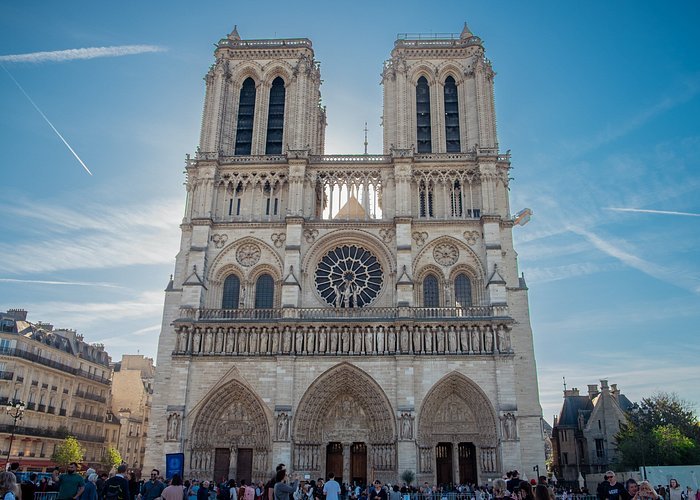
- Leave by the north. It puts you back on the parvis with the facade in front of you.
To understand the structure holding all this up, read our guide to the architecture of Notre-Dame; for the relics and furnishings in depth, see art and treasures inside the cathedral. If you would rather have it read to you as you go, the tour comparison covers which formats put a guide beside you.
Ready to book a Notre-Dame tour?
Compare the guided tours and skip-the-line options side by side, from $24, all with free cancellation.
See all Notre-Dame toursWhich of these you actually get to see depends on the tour you pick — the Notre-Dame Cathedral Tours listings say what each one covers.
Tours that fit this trip
Chosen to match what this guide covers, not for what sells.
Inside Notre-Dame Tour with a Licensed Guide
The interior read properly: a licensed guide beside you for the whole inside portion, in a group capped at seven.
From $78 per person
Check Availability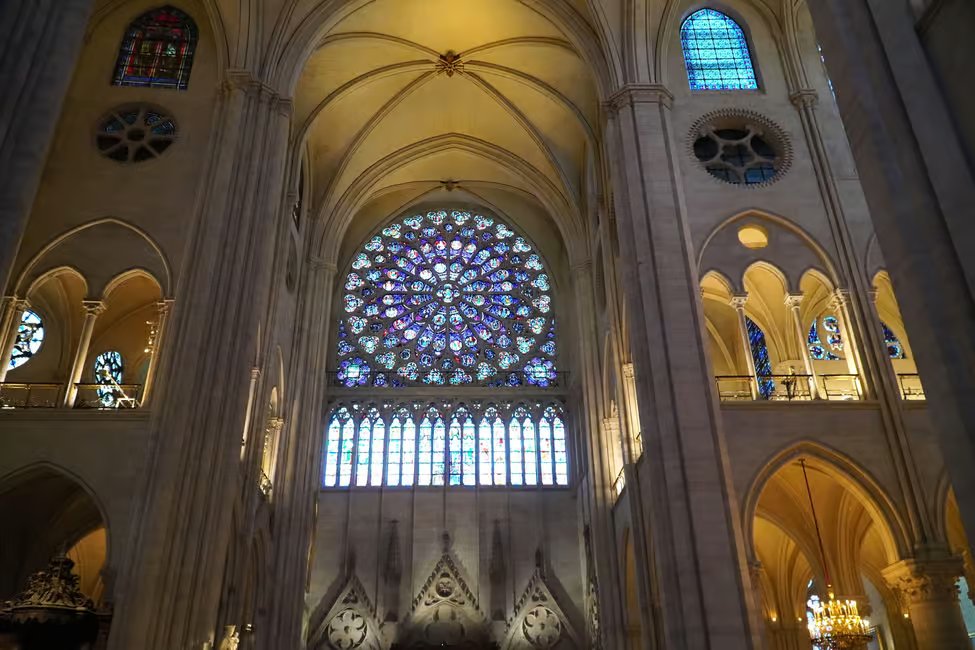
Paris Notre Dame Cathedral Guided Tour with Scheduled Access
Headsets that carry in a busy nave, which is the practical answer to a crowded interior on a summer afternoon.
From $91 per person
Check Availability
Private Historical Tour of Notre Dame
For the choir screen, the Mays and the things this post says are easiest to miss — a private art historian has the time to stop at all of them.
From $290 per person
Check Availability