Notre-Dame is the rare monument where the main event costs nothing. That makes the buying decision unusually honest: you are never paying to get in, only for a guide and sometimes for a shorter wait. Here is who should pay, who should not, and the exact question that separates them.
In this guide
- What free actually gets you
- How does the free reservation work?
- What a paid tour adds
- The rule that changes everything
- Free, reserved and guided, compared
- Skip-the-line, reserved access and neither
- Who should not pay
- Who should
- The tickets no tour can sell you
- Is this a scam?
- Does the month change the answer?
- The one question that decides it
What free actually gets you
Entry to the nave of Notre-Dame is free, has always been free, and no ticket is sold for it. That is not a promotion or a post-reopening gesture; French cathedrals are state property under the 1905 law and admission to the place of worship is not chargeable.
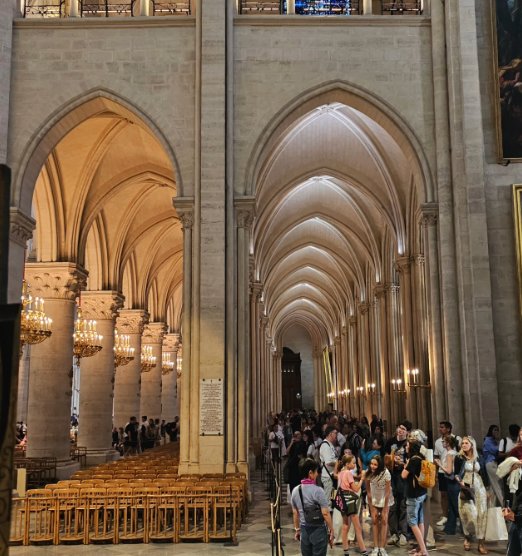
What free gets you is the whole cathedral as a visitor experiences it: the nave and its vaults, all three rose windows, the great organ, the ambulatory and its chapels, the choir screen, and the Virgin of Paris. There is no upgraded route, no premium level, no part of the visitor circuit that money opens.
That is the fact the rest of this rests on. Every paid product here is selling a person or a queue position, never a door.
How does the free reservation work?
Since the December 2024 reopening the cathedral runs a free, optional timed-reservation system on its own website. You choose an arrival window, you get a QR code, and you use the reserved-entry side of the parvis rather than the general line.
Two things about it catch people out. Slots are released on a rolling basis roughly two to three days ahead, not weeks, so trying to book it with your flights simply fails. And missing your window is not a disaster: you rejoin the general queue, which is where you would have been anyway.
Between November and March the walk-in wait is usually short enough that the reservation is a convenience rather than a necessity. From April to October it is worth the two minutes it takes.
What a paid tour adds
Three things, and it is worth separating them because listings tend to blur all three into one price.
- A reading of the building. Which portal figures are medieval and which are Viollet-le-Duc’s, what the flying buttresses are actually doing, what burned in 2019 and what was carried out. This is the substance and it is what free entry does not give you.
- A queue position, sometimes. Some listings hold genuine reserved or skip-the-line access. Many do not and walk you through the free public line. The difference is worth money in July and worth nothing in February.
- A structure for the morning. A meeting point, a route, a finish time. Underrated by people who plan well and genuinely valuable to people who do not.
Notice what is missing from that list: entry, a better view, or access to a restricted area. None of those is for sale.
The rule that changes everything
Notre-Dame restricts spoken guiding inside the cathedral. Guides may accompany a group in, but the running commentary happens outside on the parvis.
This is the single most important thing to understand before you buy, because it reshapes what a tour is. The good operators have adapted: they give you the full narrative outside in front of the portals, then take you in briefed, with a list of things to find. The weaker ones sell an “interior guided tour” and then go quiet at the door, and the reviews say so.
The practical consequence is that the outside half is where the money is. If a listing spends its description on the interior and says nothing about the parvis, that is a signal.
Free, reserved and guided, compared
| Route | Cost | Typical wait, July | Typical wait, February | What you get |
|---|---|---|---|---|
| Walk in, no reservation | Free | 45 min – 2 hrs | 5–15 min | The whole cathedral, unguided |
| Free timed reservation | Free | 5–15 min | Under 5 min | The same, past the general line |
| Guided, no reserved access | From $24 | Same as walk-in, with company | 5–15 min | A licensed guide on the parvis, then in with the group |
| Guided, reserved access | From $70 | 10–20 min | Under 10 min | A guide plus a held entry arrangement |
| Guided combo with Sainte-Chapelle | From $77 | Two queues, one held | Both short | A guide across two buildings, Sainte-Chapelle entry pre-booked |
| Private or semi-private | From $119 | Depends on the listing | Short | The guide’s full attention and a pace you set |
Read down the February column and the argument for paying almost disappears. Read down the July column and it makes itself.
Skip-the-line, reserved access and neither
These three are not the same product and the price gap between them is real. Getting the distinction right is most of what protects you from overpaying.
Genuine skip-the-line
The operator holds entry and walks you past the general queue. Rare at Notre-Dame precisely because entry is free and unticketed, and more common at Sainte-Chapelle, where it has real value.
Reserved or scheduled group access
The group has an arranged entry arrangement at a set time. Usually shortens the wait considerably, does not always eliminate it, and is the most common of the three at this monument.
Neither
You enter through the free public line with your guide beside you. Perfectly reasonable at 8 AM in March, painful at 3 PM in August. A good number of the cheaper listings sit in this category, and the good ones say so.
Who should not pay
Four profiles, and they cover more readers than the tour listings would suggest.
- You have read up already. If you know what a flying buttress does and who Maurice de Sully was, a guide is repeating you. Take a free reservation, go early, and spend the money on Sainte-Chapelle instead.
- You are visiting between November and March. The queue is short, the crowd is thin, and the main thing a paid tour buys in season is simply not on sale.
- You have thirty minutes. A one-hour tour does not fit into a half-hour gap. Walk in, look up, find the Virgin of Paris, leave.
- You are travelling with small children. A guided hour is a long time for a five-year-old. Twenty free minutes inside and a run around Square Jean XXIII is the better trade.
Who should
And four where the money is well spent.
- It is your first time and you want to understand it. The portals alone repay a guide. Almost nobody works out the Last Judgement tympanum unaided.
- You are visiting in July or August. Reserved access is worth real money when the alternative is ninety minutes on an unshaded stone forecourt.
- You want Sainte-Chapelle too. The combo’s pre-booked entry skips the Palais security queue, which is the slowest line on the island.
- You are an enthusiast. A private or semi-private guide is the only way to ask two hours of questions, and at this building there are two hours of questions.
The tickets no tour can sell you
Three parts of the cathedral complex are ticketed, and none of them is available through any guided tour, here or anywhere else.
| What | Roughly | Where it is sold | The catch |
|---|---|---|---|
| Bell Towers | €16 | Centre des monuments nationaux, online | 422 steps, timed entry, no counter on site — if you did not book, you are not climbing |
| Treasury | €12 | At the entrance inside the cathedral | Cash or card on the door; not bundled with any guided tour |
| Archaeological Crypt | €9 | Own entrance on the parvis | Separate schedule from the cathedral; easy to arrive after it has closed |
If a listing implies tower access, read it twice. The Bell Towers climb is self-guided and sold by the state monument body, and no operator has a route around that.
Is this a scam?
Not usually, but the free-entry fact creates a grey market worth naming. The clear-cut case is a site selling “Notre-Dame entry tickets” as a standalone product. There is no such thing, the entry it promises is free to everyone, and you should close the tab.
The subtler case is a listing that bundles free entry into a price and calls it admission. That is not always dishonest — some operators genuinely hold reserved group access, which has value — but the test is simple: is a guide included, and does the listing say what the reserved access actually is? If the answer to either is no, you are paying for air.
The safe routes are three: the cathedral’s own website for free reservations, the Centre des monuments nationaux for the towers, and reputable booking platforms for guided tours with a named operator and a review count.
Does the month change the answer?
More than any other factor. The whole paid proposition at Notre-Dame is a guide plus a queue, and one of those two is seasonal.
From November to March, walk-in waits are typically five to fifteen minutes and the free reservation is a nicety. A tour is then worth exactly what the guide is worth to you, and nothing more. From April to October the queue is a real cost, and reserved access starts earning its price. In July and August it is the main thing you are buying.
The other seasonal factor is the liturgical calendar, which closes tourist circulation without warning on the great feasts and during services. That affects free and paid visitors equally, and it is worth checking before you build a morning around a specific hour.
The one question that decides it
Do you want to be told what you are looking at?
If yes, book a guide, and pick the format by group size rather than by price — a cap of five means your questions get answered and a cap of twenty means headsets. If no, take the free reservation, go in the first hour after opening, and read one guide to the interior before you walk in.
Everything else — skip-the-line, reserved access, combos, private upgrades — is a modifier on that answer, not a substitute for it. And whichever way you go, the cathedral itself costs nothing, which is worth remembering when a listing tries to price it.
Common questions
Is entry to Notre-Dame really free?
How far ahead can I book the free reservation?
If entry is free, what am I paying a tour for?
Will the guide talk inside the cathedral?
Which is better in summer, the free reservation or a tour with reserved access?
Can a tour get me into the Bell Towers?
Where to go next
- What a Notre-Dame tour costs — once you have decided to pay, what the tiers buy
- Building the Île de la Cité half-day — whether Sainte-Chapelle changes the calculation
- Hours, security and the reservation system — the practical mechanics in full
- Every question travellers ask — dress code, bags, accessibility, worship
- Notre-Dame guided tours — what a guide adds that a free reservation does not
Tours that fit this trip
Chosen to match what this guide covers, not for what sells.

Paris: Notre-Dame Cathedral Interior and Exterior Guided Tour
If the answer is yes, start here: a certified Parisian guide, a group capped at five, and the lowest guided price on the site — entry through the free public line with your guide.
From $24 per person
Check Availability
Notre-Dame Interior or Exterior Tour with Scheduled Group Access
The reserved-access tier, for readers whose answer was “yes, and it is July” — scheduled group entry rather than the general queue.
From $69 per person
Check Availability
Notre Dame de Paris: Semi Private or Private Guided Tour
For the enthusiast profile: semi-private or fully private, which is the only format with room for two hours of questions.
From $119 per person
Check Availability