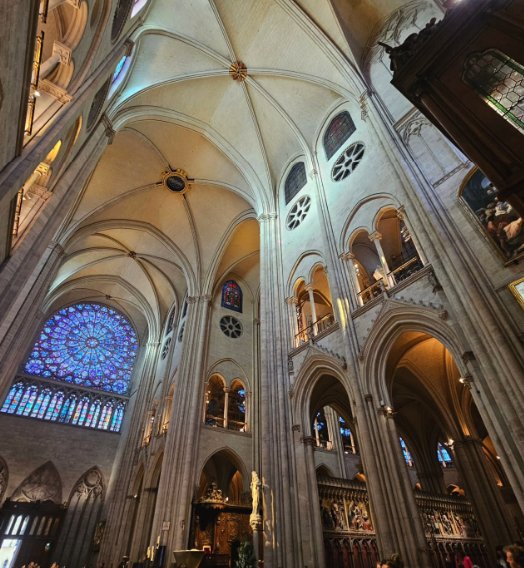
Three monuments sit within four hundred metres of each other on one island, and almost every Notre-Dame tour quietly assumes you have decided which of them you are seeing. This works through the pairings — what each adds, what it costs you in queueing, and the one case where a combo tour genuinely beats booking separately.
In this guide
- Three monuments, four hundred metres
- Is Notre-Dame enough on its own?
- What Sainte-Chapelle adds
- What the Conciergerie adds
- The four pairings, compared
- Does a combo tour beat booking separately?
- Where the time actually goes
- What each pairing costs
- Which pairing suits which traveller
- The order to do them in
- Four ways this goes wrong
- The short verdict
Three monuments, four hundred metres
The Île de la Cité is small. From the parvis in front of Notre-Dame you can walk to Sainte-Chapelle in six or seven minutes and to the Conciergerie in eight, and the two of those share a courtyard. That proximity is what makes the half-day possible and also what makes it a decision: everything is close enough that adding one more feels free, and none of it actually is.
What separates them is not distance but security. Notre-Dame has one queue. Sainte-Chapelle and the Conciergerie sit inside the Palais de Justice complex and share a single, slow bag check, which is the choke point of the whole island and the reason a pre-reserved slot there is worth more than a pre-reserved slot at the cathedral.
Notre-Dame is free. The other two are ticketed by the Centre des monuments nationaux, and they sell a joint ticket for the pair. So the real question is not which three you want, but which paid tickets are worth their queue.
Is Notre-Dame enough on its own?
For a lot of travellers, yes. A guided hour on the parvis followed by a walk through the nave gives you the thing you came to Paris to see, and it does so without a ticket, a timed slot or a second security line. If your day already has the Louvre or Versailles in it, adding a second island monument is how a comfortable morning becomes a forced march.
The cathedral rewards slowness more than most buildings do. The three rose windows read differently as the sun moves, the choir screen is easy to walk past, and the restored stone is genuinely startling for anyone who saw the interior before 2019. An unhurried hour inside is worth more than forty minutes there plus forty minutes somewhere else.
The case for adding something is narrower than it looks. It rests almost entirely on Sainte-Chapelle, and specifically on the fact that its upper chapel is unlike anything else in the city.
What Sainte-Chapelle adds
Sainte-Chapelle was built in the 1240s by Louis IX to house the Crown of Thorns, and its upper chapel is fifteen windows of thirteenth-century glass standing in place of walls. It is roughly two-thirds original medieval glass, restored rather than replaced, and on a bright afternoon the effect is one of the reasons people book a trip to Paris in the first place.
It is also small, and it fills. The upper chapel holds a few hundred people at a squeeze and the staircase up is a bottleneck. This is why a timed, pre-reserved entry is not a nicety here: the difference between a reserved slot and a walk-up in July is regularly an hour and a half.
The pairing logic is strong. Notre-Dame gives you scale, structure and eight centuries of national history; Sainte-Chapelle gives you colour and light in a single room. They are not the same experience with different postcodes, and seeing them within an hour of each other is genuinely the best way to understand what Gothic glass was for.
What the Conciergerie adds
The Conciergerie is the medieval royal palace that became a revolutionary prison, and it is where Marie Antoinette was held before her execution. The Salle des Gens d’Armes is one of the largest surviving medieval halls in Europe, and the reconstructed cells and the memorial chapel make it the most narrative of the three monuments.
It is also the quietest and the least visited, which is either a recommendation or a warning depending on what you want from a morning. It has no equivalent of a rose window; what it has is atmosphere and a story, and it takes forty-five minutes to do properly.
The practical argument for it is the joint ticket. Because it shares its complex and its ticketing with Sainte-Chapelle, adding it costs a few euro rather than a full admission, and you are already through the security line. If you are doing Sainte-Chapelle and you have the time, the marginal cost is low. If you are not, the Conciergerie on its own rarely wins the slot.
The four pairings, compared
Times below assume a reserved slot where one is available and a moderate-season queue where it is not.
| Pairing | Time needed | Paid tickets | The case for it | The case against |
|---|---|---|---|---|
| Notre-Dame alone | 1–1.5 hrs | None — entry is free | Unhurried, no second security line, works for any schedule | You are four hundred metres from the best glass in Paris and not seeing it |
| Notre-Dame + Sainte-Chapelle | 3–3.5 hrs | One (or a joint ticket) | The strongest pairing: scale and structure, then colour and light | Two security queues; Sainte-Chapelle can close at short notice in extreme heat |
| Notre-Dame + Conciergerie | 2.5–3 hrs | One | Quietest option; the revolutionary story you get nowhere else on the island | Skips the one thing most visitors would regret missing |
| All three | 4.5–5 hrs | Joint ticket | Marginal cost of the third is small once you are inside the Palais complex | A half-day becomes most of a day; the cathedral gets the shortest visit |
The table hides one thing worth stating: the two Palais monuments share a queue, so the third monument costs far less time than the second did.
Does a combo tour beat booking separately?
Sometimes, and the reason is narrower than the listings suggest. A combo tour is not buying you a better view of Sainte-Chapelle; it is buying you a pre-reserved, skip-the-line entry to it, and a guide who reads both buildings in one continuous narrative rather than two disconnected visits.
The reserved entry is the concrete part. In July and August the walk-up security queue at the Palais complex can run past an hour, and a tour that holds group entry walks past it. The guiding is the softer part but it is real: the connection between the two buildings — the same king, the same relic, the same decade of the thirteenth century — is exactly the thing an unguided visit misses.
Where it does not pay is out of season. In February you can buy both tickets yourself, walk in within ten minutes, and spend the difference on lunch. The combo premium is a queue premium, and in winter there is no queue to jump.
Where the time actually goes
Travellers plan the half-day around the monuments and are then surprised by where the hours went. Broken down, a three-monument morning without reservations looks roughly like this.
- Notre-Dame entry line: ten minutes off-season, thirty to well over an hour between April and October on a walk-up.
- Inside the cathedral: forty-five minutes to an hour, and worth every minute of it.
- Walking to the Palais complex: six to eight minutes, less if you cut through the flower market.
- Palais security: the big one. Fifteen minutes in winter, an hour or more in high summer, shared by both monuments.
- Sainte-Chapelle upper chapel: thirty to forty minutes, including the staircase queue.
- Conciergerie: forty-five minutes done properly, twenty if you are rushing it, which is a waste.
Add it up and the walking is under fifteen minutes of a four-hour morning. Everything else is either looking or standing still, and reservations move time from the second column into the first.
What each pairing costs
Cathedral entry is free and always has been. What follows is what you pay on top, and it is worth seeing laid out because the guided and unguided routes diverge sharply once a second monument enters the picture.
| Route | Roughly | What you are buying |
|---|---|---|
| Notre-Dame, unguided, free reservation | Nothing | The nave, the roses, the restored stone — the whole cathedral |
| Notre-Dame, guided | From $24 | A licensed guide reading the portals and the interior; sometimes reserved access |
| Sainte-Chapelle, direct | Around €13 | Timed entry to the upper chapel, booked yourself |
| Sainte-Chapelle + Conciergerie joint, direct | Around €20 | Both Palais monuments on one ticket and one security queue |
| Guided combo, both monuments | From $77 | Reserved Sainte-Chapelle entry plus a guide across both buildings |
| Semi-private guided combo | From $185 | The same, capped at eight, with the guide’s full attention |
The gap between the third row and the fifth is where the decision sits. You are paying roughly sixty dollars for a guide and a queue, and whether that is good value depends almost entirely on the month.
Which pairing suits which traveller
Four profiles cover most readers, and the recommendation is different for each.
First time in Paris, one free morning
Notre-Dame and Sainte-Chapelle, guided, in that order. You get the two things you will describe when you get home, and the guide connects them. Book a slot before ten.
Returning visitor who has seen the cathedral before
Sainte-Chapelle and the Conciergerie on the joint ticket, then twenty minutes in the restored nave to see what changed. The cathedral is a different building since the cleaning, and half an hour is enough to register it.
Travelling with children
Notre-Dame alone, early, then the Seine. Two security queues and a fifteen-minute staircase are how a good morning ends badly. The Conciergerie’s prison cells hold older children well; the upper chapel rarely holds anyone under eight.
Architecture or history focused
All three, on a weekday morning, with the joint ticket bought in advance. Start at the cathedral at opening, be through Palais security by half past ten, and give the Conciergerie the full forty-five minutes it deserves.
The order to do them in
There is a correct order and it is not the obvious one. Start at Notre-Dame, because it opens earliest — 7:50 AM on weekdays against 9:00 AM at the Palais monuments — and because its queue grows fastest through the morning.
Go to Sainte-Chapelle second, not third. The upper chapel wants sun, and the glass is at its best from late morning onward; arriving there at nine to a grey interior is a waste of the one thing it does better than anywhere in Europe.
Finish at the Conciergerie. It is artificially lit, so the hour makes no difference to it, and it is the one of the three where being tired matters least — you are reading panels and walking through halls rather than craning at a ceiling.
Four ways this goes wrong
- Buying “Notre-Dame entry tickets.” No such product exists. Entry is free; if a site is charging for it, close the tab and take the cathedral’s own free reservation instead.
- Assuming one security queue covers the island. Notre-Dame and the Palais complex have separate checks, and the Palais one is the slow one.
- Booking Sainte-Chapelle for the end of the day. The glass needs light. A four o’clock November slot is a room with dark windows in it.
- Planning around the Bell Towers. The 422-step climb is a separate ticket from the Centre des monuments nationaux, self-guided, and no tour on the island includes it. Allow ninety minutes to two hours if you want it, and treat it as a fourth monument rather than an add-on.
The short verdict
Notre-Dame plus Sainte-Chapelle is the pairing to beat. It takes three hours, it costs either about thirteen euro or about seventy-seven dollars depending on how you buy it, and it gives you the two most photographed interiors on the island without either feeling rushed.
Add the Conciergerie if you have the morning and the joint ticket, skip it if you do not. And if the day is tight, take the cathedral on its own and take it slowly — that is a better half-day than three monuments at a trot, and it does not cost anything at all.
Common questions
Can I see all three monuments in one morning?
Is the Sainte-Chapelle combo tour worth the extra?
Do I need a ticket for Notre-Dame?
Which monument should I drop if I am short on time?
Can I climb the towers as part of this?
What if Sainte-Chapelle is closed when I arrive?
Where to go next
- The island in ninety minutes — the route, timed, once you have chosen your pairing
- What a Notre-Dame tour costs — the $24 to $291 spread, itemised
- The architecture of Notre-Dame — why the walls could become glass in the first place
- Visitor information in full — hours, security, dress code, the free reservation
- Notre-Dame Cathedral Tours — every listing, with live prices and what each one covers
Tours that fit this trip
Chosen to match what this guide covers, not for what sells.
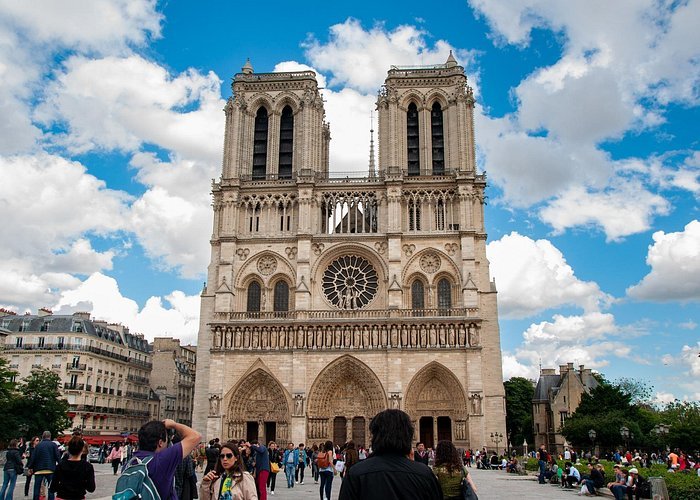
The Ultimate Notre-Dame Cathedral & Ile de la Cite Walking Tour
The island walk in tour form: Square Jean XXIII, the Seine quays and the whole Île de la Cité before the cathedral, with a Sainte-Chapelle upgrade available at booking.
From $68 per person
Check Availability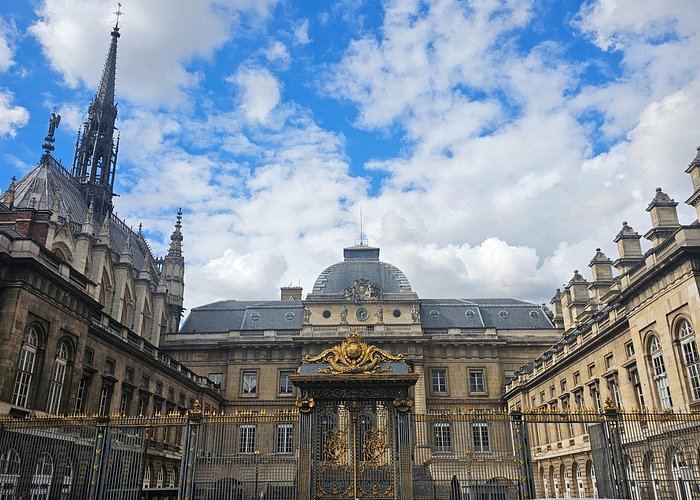
Notre Dame Outdoor Walking Tour and Entrance to Sainte Chapelle
The combo done properly — a guided exterior tour of Notre-Dame followed by pre-reserved, skip-the-line entry to Sainte-Chapelle, which is the queue that actually costs you time.
From $76 per person
Check Availability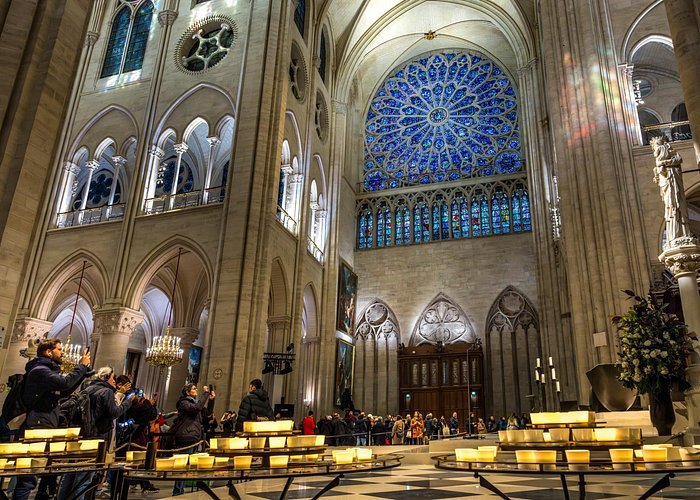
Paris Notre Dame Cathedral and Sainte Chapelle Semi Private Tour
The premium version of the same pairing, capped at eight, if you want the two buildings connected by a guide with room to answer questions.
From $184 per person
Check Availability